Poland is jumping on the EV bandwagon as well

PolandDespite being one of the largest countries in Europe and with the economy that managed to escape recent financial turmoils relatively unscathed, Poland is lagging behind when it comes to electric vehicles or curbing pollution.

Early in 2017, the government has laid down the plans to change it. Named Electromobility Development Plan. Part of the plan assumes that by 2025 there will be 1 million electric vehicles on the roads (today there’s approximately 26,5 million cars registered), which should help to eliminate at least some of the smog in the busy cities.

The other incentives will include:

  • No excise duties for EVs and no property tax for the households equipped with a charging station,
  • supporting and building charging infrastructure (something that is terribly lacking today, there were only few hundreds of those by end of 2016 in the whole country),
  • replacing the gas-guzzling buses with electric ones,
  • establishment of Zero Emission zones.

Some developments are already on the way. ElectroMobility Poland is supporting an initiative to design an in-house EV (some of the winning concepts are shown here). Some of the cities are working on electrifying their bus fleet. Polish manufacturer Solaris already has an electric bus in their offering.

It is all for a good cause. I think the next logical step would be to focus on renewable energy sources such as wind and solar, as majority of country’s electricity comes from burning coal.

It’s never too late and this is definitely a step in the right direction!

Tesla adds a trip planner to their website

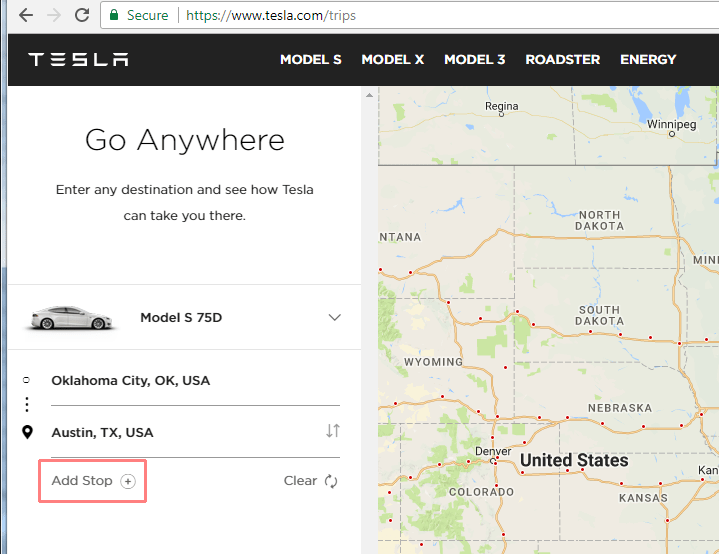
Similarly to a trip planner in the car, Tesla has introduced a new feature on their website now, called Go Anywhere.

Tesla_trips_sample_route

A bit of fiddling around and I found several differences right away:

  • When selecting the model of the vehicle, only the current production lineup is available. For example, you can only select S 75D (with dual motor), since the RWD model S is no longer available. Similarly, you can’t select a Roadster or any of the previous battery pack capacities (60, 70, 85 or 90).
  • It assumes 100% initial state of charge and it doesn’t show the remaining capacity when arriving at the supercharger (only an estimate on how long it will take before you can get going).
  • You can click on the Supercharger icon to find more information about it, but it doesn’t display the current status (available or how many stalls are in use).
  • It does not have an option for a round trip.
  • It also doesn’t seem to account for elevation changes, wind etc.

The website has its quirks, too. As cleverly spotted by one of the TMC forum members (BerTX), it does some funky stuff when calculating the route where there’s no adequate Supercharger coverage along the way:

Tesla_trips_quirky

It would make for a heck of a road trip if one would follow that suggestion!

As far as I can tell, there’s one new feature that Tesla vehicles are lacking – you can add stops to your itinerary:

Tesla_trips_add_stop

Way points have been requested by Tesla owners for a long time now, hopefully this is a sign that it will be introduced in the cars as well.

An introduction of the trip planning tool coincides with a recent tweet from Musk about the revamped navigation system coming our way and I am starting to wonder if this is just a teaser of what’s coming. Wouldn’t it be great if we could plan the whole trip on the computer or phone and download it to the car using the Tesla app? I guess time will tell if there are more works on the way. There are some reports already about updated maps being pushed to the fleet, so hopefully we won’t have to wait too long!

As it is, the tool seems to be targeting potential buyers more than the existing owners, so they can try and see where the car of their choice could bring them.

First World problem solved – enter automatic windshield wipers in Tesla!

As reported in this thread on TMC (Tesla Motors Club) forum, there is a new update being pushed to the fleet that enables automatic wipers on Tesla Models S and X with Autopilot hardware 2.x. Cars with AP 1.0 already had that feature (using rain sensor, just like many other higher-end cars). The difference is that the newer Tesla cars don’t have a dedicated sensor anymore. Instead, the car was supposed to use some of the cameras that the car is equipped with. The feature has been long promised by the automaker. So much so that it has became a number two complain on the list by the unsatisfied Tesla owners feeling cheated and lied to by this omission. Number one would have to be the promise of Autopilot and Full Self Driving (FSD) capabilities, but I guess it depends on whom you ask in particular. I know, First World Problems from the people that already own and drive the best car on the planet ;).

I think there were numerous valid reasons for the delay. Not an insignificant one being the parting of the ways between Tesla and Mobileye, the latter of which was responsible for most of the developments around autonomous driving until then. Assembling a new team and starting to develop your own know-how in a discipline which is not exactly as old as bread baking takes time. Creating the software algorithms that would allow for the cameras to detect precipitation without interfering with the rest of the functionality designed around EAP/FSD poses a great challenge and most likely was not on a priority list, either.

The feature is available in software release 2017.50.3 as a beta. As far as I know, it is also the industry-first implementation that uses cameras and neural network bits instead of traditional sensors. There’s a number of companies holding patents or having technology around vision-based rain sensing, but seems that Tesla is the first to actually implement it!

How does it work? Is it better than the systems in other cars currently on the market? Is it capable to replace human intervention with manual adjustments of sensitivity/speed? I will be happy to report as soon as my car gets the update!

How much luggage can our Model S carry?

It was great having family in town during the holidays. Unfortunately, all good things come to an end – people have to get back to work, school etc. Dropping them off at the airport provided an opportunity to test some cargo capacity of Model S 🙂

We knew that it can comfortably sit 5 people. What about their luggage though? My wife suggested that we drive our other car (an aging SUV) instead, but I am stubborn and would not give up that easily. I decided to put Tesla to the test:

As you can see, not only is it a great people carrier, but also offers ample space for the luggage for 5 people. Who needs an SUV!

Luggage

Year 2017 in retrospect

It feels like the year just barely started and now we have just days left before it is over! I am not sure if this is me aging or a general trend, but it sure seems like time escapes before our eyes faster and faster. Anyway, I thought it was a good time to recollect what 2017 has brought us as far as the electric vehicle market is concerned. There’s no way I can recap all that the world has been working on in this area, but these are the news and events that deserve the mention in my opinion.

January:

February:

March:

April:

May:

June:

  • President Trump withdraws US from Paris Climate Agreement
  • EU to bypass US government and work with business leaders and state governments instead.

July:

  • EV sales in Norway reach 42% of all new cars sold.
  • UK and France pledge to end sales of gasoline and Diesel cars by 2040.

August:

  • US electric cars’ sales up by 47% in 2017.
  • Charging stations to be deployed alongside gas stations in UK.

September:

October:

November:

December:


My personal highlights:

  • Tesla Model 3 finally available for the customers, despite the production hell.
  • China leading EV transformation with its booming adoption rate.
  • Number of countries officially declaring a phase out of fossil fuels.

There’s no way of course to capture all the exciting and groundbreaking events that took place throughout the year. I am sure I missed some important milestones and I apologize for that. One thing for sure, 2017 deserves the credit for tipping the scale and making everyone (that counts anyway) realize that this is the future and there’s no escape.

The hype is real at last!

Ho ho ho! Merry Christmas!

I always liked this time of the year. There is something magical about Christmas that no other holiday seems to provide. In the place where I was growing up the snow would be on the ground as soon as early December, so that was the first guarantee of a proper mood as the holidays were approaching. While parents were busy with last minute preparations for Christmas Eve dinner, us kids would be on a watch for a first star to appear on the sky, signaling that it is the time to sit at the dining table. There’s a lot more of great traditions related to celebrating the birth of Jesus Christ and I will probably write about it some other time. One that kids care about the most though are presents! Tesla has a nice surprise in that department as well.

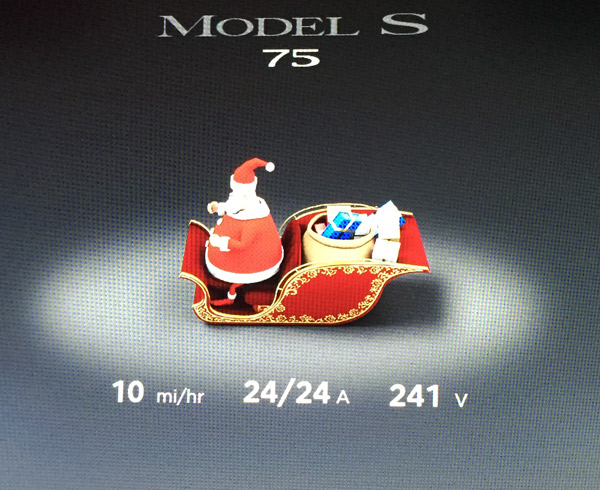
The company has been very systematic with new software updates in the past few months, delivering on the promise of bi-weekly releases. While not every car will receive every release all the time, I can honestly say that I have been receiving at least every other update on average. My last update was 2017.46 and just before Christmas I have received a notification about 2017.50.2 (talking about perfect timing). I’ll cover the  new improvements later, but the one that is simply cool to have during the holidays is the new Easter Egg (or should we call it a “Christmas” egg instead?) that turns your car into Santa’s sleigh and the cars on the road into reindeer.

IMG_3373

Here’s a quick video I made that showcases how it works:

Definitely something that satisfies the inner child in me!

There’s also a “secret” not-so-funny Easter egg that Elon had hinted in his tweet:

Here’s the spoiler for those who didn’t get the clue:

As for the other features included in this update, there’s an additional fix related to Easy Entry. Quoting the release notes:

“We’ve improved Easy Entry so that now when you park, the steering wheel and the driver’s seat adjust for an easy exit after you unbuckle the driver’s seat belt.”

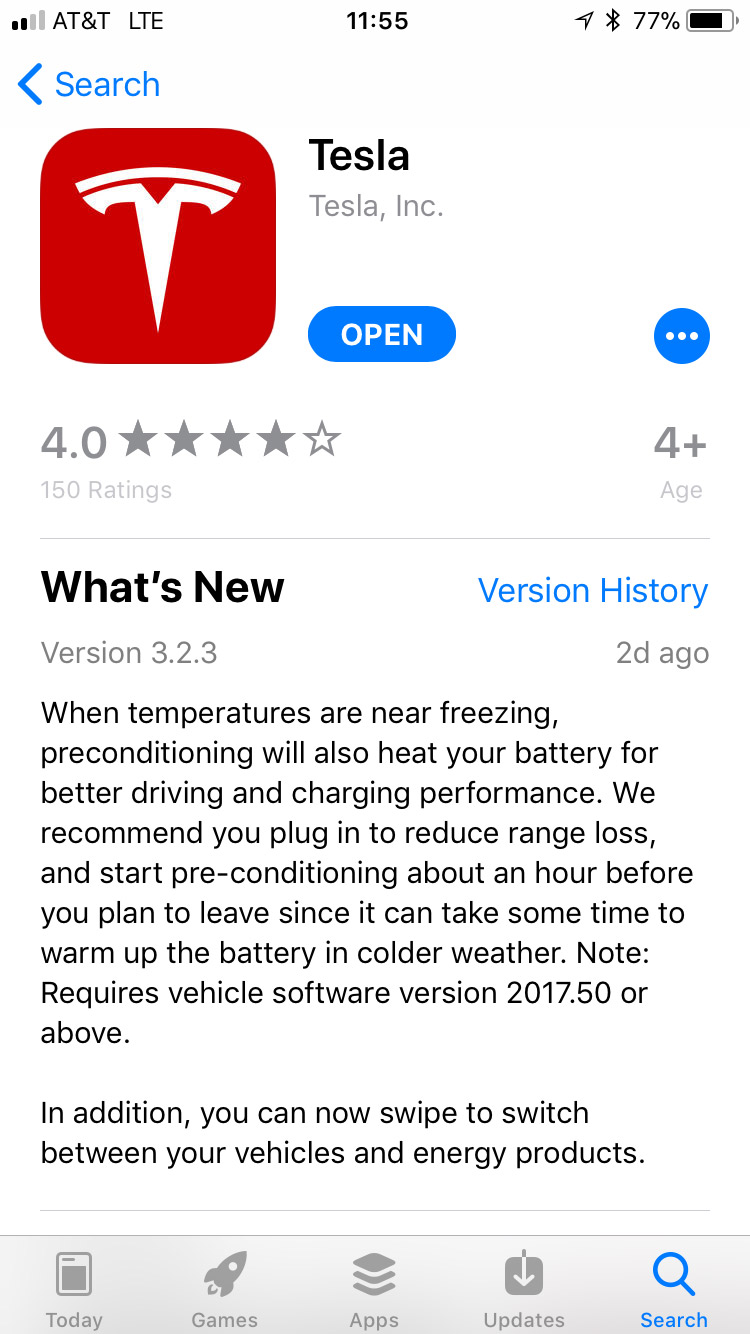
Neat. the other significant update is going to help those folks living in cold climates to preserve the battery range when plugged in. It requires both the latest version of the Tesla mobile app and the firmware version 2017.50.x (as there were a few revisions of this release). The app notes explain it quite well:

IMG_3359

So if you leave your car plugged in the garage overnight (as you should) or in the parking lot at your workplace where you have a charging port (lucky!), you can get your car nice and toasty before leaving and also take care of the battery’s temperature at the same time. Double neat.

I haven’t had a chance to test if there were any other incremental improvements to Autopilot with this update, but if I notice anything I’ll let you know. Meanwhile, wishing you all a Merry Christmas! Spend some time with your family and friends and reflect on things that matter in life the most. Till next time!


Seeing is believing

On a recent trip to Austin I have spotted this beauty parked at the Supercharger:

IMG_3326

I have asked the owner if I could snap a quick picture and he kindly agreed.

There’s plenty of reports on Model 3 sightings in various places around the country and the “VIN hunters” are as busy as they can get to predict the current production outputs. Everyone is excited to get their hands on one, or even to just get up close with the production model. This was the first in-person encounter for me and all I can say is that it looks even better in person than on a photo. The pictures I’ve seen (including my own shot above) simply don’t do Model 3 any justice. It is truly a well designed car with modern cues and fully deserving its place as a younger (and a bit smaller) sibling to Model S.

I haven’t “bugged” the gentleman that drove this car too much, there’s plenty of coverage of the interior and features out there anyway. I am excited that I could see it for myself and up close though. It is a long range model, by the way.

I hope Tesla has its worst experience behind and the production will continue ramping up, so all the folks that are eagerly waiting to configure and order one can be satisfied. This car is in position to make a true difference on the car market and speed up the EV adoption rate while looking cool and sexy. I cannot wait for the day when Model 3 is as common as Nissan Leaf or Toyota Prius on the road. Hurry up, Tesla. We are all waiting!

“Silky smooth” autopilot? “Almost” there

There are huge expectations towards what Tesla Autopilot should deliver. They are fueled by numerous bold promises from Elon Musk, as well as early adopters (such as myself) who took a plunge and purchased the car with EAP (Enhanded Autopilot) and FSD (Full Self-Driving) hardware.

Now, I knew that the technology or features were not there yet when I decided to buy into the “promise of the future”. Not everyone has the same patience or expectations though, so there’s a lot of disappointment (anger even) that the Autopilot is not what it was supposed to be by now. I get it. The inner child in us took over when we took the first bite of the full self-driving promise candy and it might have left some bitter taste afterwards. There was so much hype about autonomous vehicles and how soon they can hit the road.

The reality is (putting adult’s hat and skin back on) that no matter the hype, this is not something that can or will be delivered overnight. For what it is worth, I do like the steady but important improvements in software algorithms that drive the features such as Autopilot. Ever since Andrej Karpathy took over an AI team in Tesla there has been a steady stream of software updates to the car fleet. None of them really advertised any features related to EAP or FSD, but the changes are noticeable nonetheless. My car has been updated to version 2017.46 recently and if used as prescribed (aka read the disclaimer before enabling the “beta” of Autopilot) I dare to say it is as close to “silky smooth” as it can be. Before I continue though it is worth pointing out that not every Tesla cars receives every incremental updates. Quite commonly (as reported by Tesla owners) there will be a period of “drought” where the car does not receive every bit of software released and instead there will be a jump (from 2017.3x to 2017.4x, for example). With that said, some of the more noticeable changes I have been observing since 2017.32 include:

  • The car will stay centered in the lane and any minute adjustments are hardly noticeable (as opposed to the “ping-pong” effect where the car used to go from the left to right lane marker all the time);
  • No more hugging of any specific side of the lane (left tor right), as if the vehicle had its own preferences;
  • Negotiating “stay in the lane” when approaching on-ramp, off-ramp or merge lanes. It used to be that the algorithm will either try to take an unexpected exit from the highway you were travelling on or sway from left to right to occupy the whole width of the temporarily expanded width of the lane, surely making it appear to the cars merging in as if a complete jerk was driving the Tesla in front of them. Kudos for not making me appear like one anymore;
  • Handling various lighting conditions (such as driving into direct sunlight where lane markings are blending with the pavement, making them difficult to see);
  • Much faster/more frequent feedback from the sensors when it comes to monitoring adjacent lanes and vehicles in the blind spot.
  • Negotiating curvy roads at high speeds (there’s a number of spots on Interstate Highway 35 that I frequent where I question the engineering behind placing two or more sharp bends where everyone is traveling at 75 mph or faster, but I digress).

Overall, it “feels” as close to natural (human-like) as it gets. Below is a sample video showcasing the behavior during bright daylight, driving mostly into the morning sun:

Another sample of the same road during the night:

I have been using Autopilot on almost daily basis now and it comes very handy. Paired with TACC (Traffic Aware Cruise Control) it helps to eliminate most of the stress related to daily commute. Its behavior is more predictable (most importantly, consistent) with the recent release, so that’s a bonus.

There are still some things that require more work and improvement before it is prime time ready. Few of the glitches that still exist that I should point out:

  • “Ghost” braking. On certain stretches of the freeway (most notably where there was recent reconstruction or widening such as commenced during 35express project, the system “thinks” I am driving along what used to be a frontage road and immediately issues a warning that auto-steering assistance is limited to 45 or 50 mph. Very dangerous if it catches you off-guard when flowing with the rest of the traffic at a freeway speeds! On a stretch of I-35 I travel along it happens 3 times on a stretch of 20-odd miles. At least it is consistent, so I am prepared to respond, but the whole point of Autopilot is to give you reassurance and confidence that the system is working as intended, not take away from it.
  • The system is limited to work on multi-lane freeways and divided highways. While it might work on a farm road with clear road markings Tesla is cautioning not to use it on such roads yet.
  • Speaking of clear markings, you better watch for that too. Don’t take unnecessary risk on a temporarily re-striped pavements, construction zones, tight city streets etc.
  • It should not be used in heavy rain or snow (the accumulation of the latter can interfere with the radar and sensors).
  • It doesn’t read the speed signs or other traffic signs just yet (such as stop), so you have to pay attention to those and adjust speed (or stop) accordingly.
  • The autopilot (more likely TACC in this case) will not respond to the vehicles and objects ahead of you that are stationary, so pay attention when approaching a fully stopped traffic (such as traffic lights at the intersection or an incident)!

To sum things up, there’s still a lot of missing gaps that have to be addressed before the Autopilot can truly be used in any condition and on any road. I don’t believe this is something that can (safely!) happen overnight and we will see steady incremental developments leading to self-driving cars. This is why the feature is still available as a beta and as such should be used with a does of caution (RTFM, people). As of now, Autopilot and other driver assistance features are just this: a helper to alleviate some of the pains related to mundane commute and make them less severe. Don’t use them against what they are capable of and keep everyone (including yourself) safe on the road.

“There’s only one thing beyond ludicrous, which is plaid”

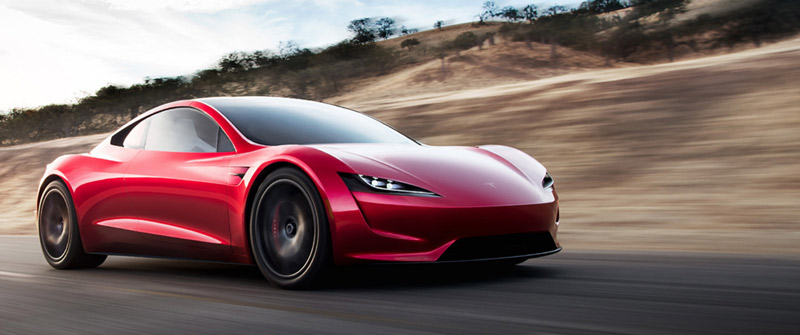
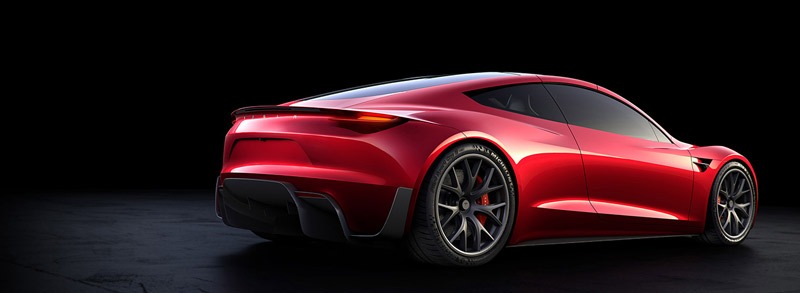
The Semi event is behind us. No more speculations then on what could be the “other” surprise that might be presented during that very evening. Enter the next generation Roadster. What a beauty:

Tesla-Roadster

Behind that pretty face there are some mean facts:

  • 0-60 mph in 1.9 seconds – faster than ANY production car ever (0-100 mph in 4.2 if you care).
  • A quarter mile in 8.9 seconds  – first production car to go under 9 seconds.
  • 620 miles (more than 1000 kilometers) of range at highway speed – first electric car to achieve this,
  • 200 kWh battery – the largest capacity in an EV so far,
  • 10000 Nm of torque – even Elon calls it “Stupid”,
  • 250+ mph maximum speed.

Wow. No, more like WOW! Lucky those who had a chance to experience the crazy acceleration during the event. No wonder everyone flocked immediately to the Roadster once the presentation was complete. It has definitely stolen some of the spotlight from the Semi, but justifiably so.

The intention is clear as well. To quote Mr. Musk again “the point of doing this is to give a hardcore smack down to gasoline cars” and “driving a gasoline sport car is going to feel like a steam engine with a side if quiche”. Touché.

The new generation Roadster will go into production in 2020 and will have a base price tag of $200,000 ($50,000 more for Founders Edition). While most of us can only dream about owning one, quite a few have already placed a reservation (a mere $50,000 for base model). No surprise, as this is going to be faster than ANYTHING currently offered on the market, even among the super-cars that have much higher price tag. It’s all about the bragging rights! Everyone else better get used to this view instead:

Tesla-Roadster-(rear)

What a gorgeous car it is …

BAMFed!

Tesla-Semi

So, I didn’t stay awake to catch the Tesla Semi reveal after all. Affected by a jet lag after my recent trip to Europe I fell asleep before the event started. Not to fret, there’s plenty of coverage of the event to indulge, devour and dissect.  What an evening it was!

I was right that the Semi is going to be a stunningly looking vehicle. No disappointment there, as Tesla shows off yet another beautifully designed product. Following the cues of other Tesla cars (most notably Model 3, at least as far as the “nose” is concerned) the truck looks slick and futuristic. Smooth lines provide not only a visually and aesthetically pleasing outcome, but most importantly help to achieve great drag coefficient (0.36 as mentioned during the event, better than Bugatti Chiron at 0.38 or an average truck at 0.65-0.70). Elon Musk has started with a strong note citing BAMF performance (or as he has put it, a technical term they came out with *wink*). Here are some numbers:

  • 0-60 mph in 5 seconds (truck by itself or with an empty trailer)
  • 0-60 mph in 20 seconds (with maximum allowed gross weight of 80,000 pounds)
  • Ability to climb 5% grades at 65 mph
  • 500 miles of range (300 for a base version)
  • 4 independent motors at the rear wheels
  • Single gear (just like in Model S or X)

If these numbers hold true till production model is available, trucking will never be the same again!

The Semi is not only pretty, but innovative and functional. The driver’s seat is in the center of the cabin, offering the best position and visibility. The cabin’s interior looks like the cockpit of a futuristic jet plane with 2 large touchscreens on each side of the driver. No gauges, buttons or other instruments traditionally found in the similar cargo carriers. The windshield is made of armored glass (or “thermonuclear explosion-proof glass” in Tesla terms) that should be able to withstand any road hazards.
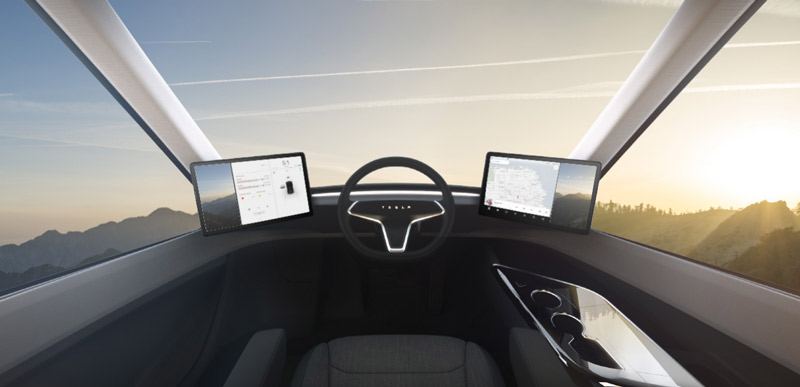
Tesla-Semi-interior

Of course, being a Tesla, the truck will be equipped with similar safety features already available in other of its cars, such as Enhanced Autopilot (EAP), Lane Keeping, Emergency Braking and Forward Collision Detection. The Semi will be able to automatically come to a full stop and make an emergency call should the driver need medical attention. Of course, the driver will also be able to use the Tesla mobile app to check on the truck. Some of the additional functions will be related to preventive maintenance, communication with the fleet service or remote diagnostics.
Another great promise was related to a convoy scenario – only the leading vehicle will be operated by the driver and the rest of the convoy will simply follow the leader. Musk claimed that this is already possible today. Sounds impressive.

Tesla’s network of Superchargers already helps the owners of Model S, X and soon 3 to overcome their range anxiety. To help with the charging needs of the bigger brother, Tesla plans to introduce Megachargers (backed up by Solar and Powerpack technology) that will allow to regain 400 miles of range in 30 mins. Elon has hinted that this can be done while the cargo is being unloaded or during rests, so most likely there’s a plan to strategically deploy the infrastructure along the truck routes/stops. Now it only makes sense to see that some of the Superchargers are already located nearby truck stops!

There was no mention about the price of the Semi. The presentation suggested that the cost to operate the vehicle will be $1.26/mile (compared to $1.51/mile for diesel truck) or $0.85 in a convoy scenario. This takes into consideration the bulk electricity rate of 7 cents per kWh when using Megachargers (guaranteed once the infrastructure is in place). They also offer 1 million miles free of maintenance for the drive train.

All things considered, Tesla Semi has a chance to truly revolutionize the transport industry. 500 miles of range should be plenty to cover most of the cargo routes. Some of the major players (such as J.B. Hunt or Walmart) already pre-ordered Semi to test in their fleets and others will most likely follow.  If Tesla delivers on their promise, they will make the history yet again. I am super excited about the Semi as presented. The driving experience will be very similar to that of Model S or X. Heck, one day I might be able to realize my childhood dream and become a truck driver myself!